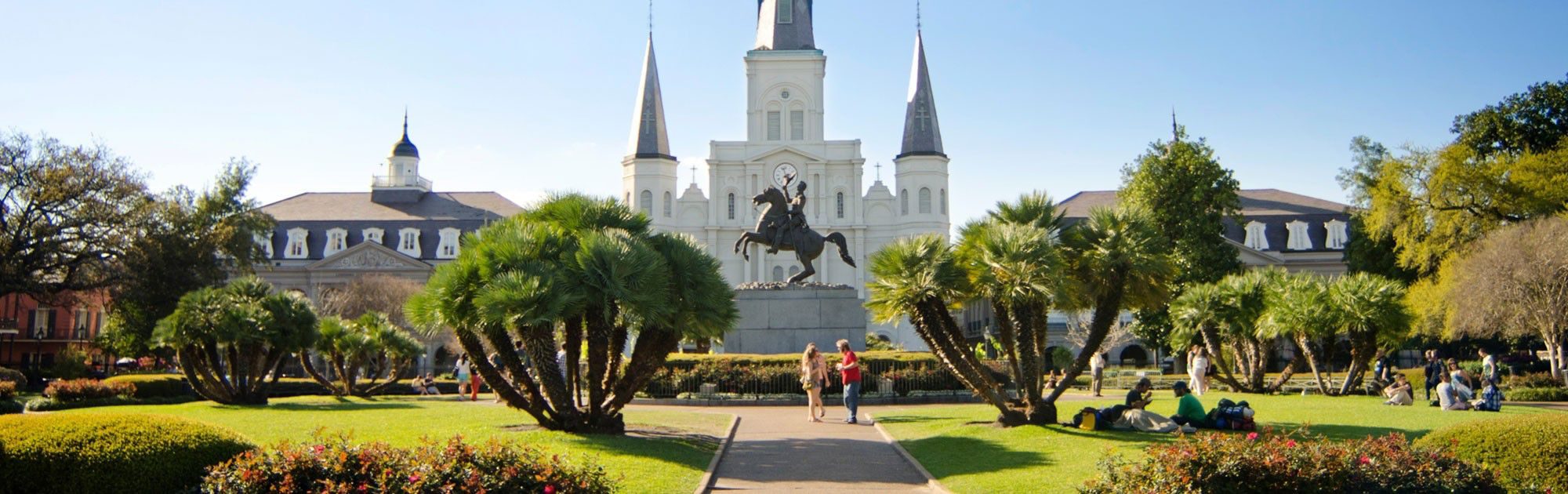
Garden District
Love at first sight is a common experience for first-time visitors to the Garden District. It often goes something like this: they’re traveling up St. Charles Avenue via the streetcar when they get their first glance of the oak tree-lined streets and historic homes. You can tell by the pristine look on their faces, that the Garden District has started a newfound romance.
The romance blooms as the afternoon is spent exploring memories of New Orleans’ antebellum past, gazing at secluded mansions, wandering down the brick-lined sidewalks. Its canopy of oak trees is world-famous, while its characteristic gardens of hibiscuses and crepe myrtles, angel trumpets, and bougainvillea, make it one of New Orleans’ most beautiful neighborhoods. The Garden District has worked its magic again.
Garden District History
Before it was the Garden District, the area was several plantations. The plantations were sold off in pieces to wealthy Americans who wanted to live outside of the French Quarter and away from the Creoles. Their homes, many of which still stand today, showcase the opulence of the wealthy newcomers to the area and the prosperity of New Orleans during that time period.
In 1833, the area officially became part of the City of Lafayette. Nearly 20 years later, in 1852 it became part of New Orleans.
Traditionally, each block only had two houses, each surrounded by a large garden, hence the name. However, in the late 1800’s some of the large lots were subdivided as Uptown New Orleans became more urban. This created a pattern of 19th-century mansions surrounded by “gingerbread” decorated late Victorian-style homes. That’s the reason why the Garden District is now known for its architecture just as much as its natural scenery.
Katrina and the Garden District
In the 1840’s as the Garden District developed and New Orleans expanded upriver, along (relatively of course, this New Orleans) higher ground near the Mississippi River. During the flooding that followed Hurricane Katrina, the area saw none of the major effects of the flooding. However, a number of homes had roof damage, caused by the hurricane-force winds.
Today in the Garden District
Today, the Garden District has returned to its pristine condition. It’s the home to a handful of the city’s premier restaurants, world-class shopping and many popular attractions like Lafayette Cemetery No. 1. A number of movies have been shot within the Garden District borders and it’s home to a number of celebrities including actors, athletes and writers.
Here, as in the past, you can sit on a shaded gallery and watch the world go by, or walk down a street lined with live oaks and enjoy, as writers and artists have before you, some of the world’s most stunning man-made beauty.
The New Orleans Garden District is home to one of the most breathtaking collections of historic mansions in the South. This area of the city was laid out in 1832 on what once was the Livaudais Plantation. By 1852, travel writers had already dubbed the area the “Garden District.” Henry Howard, James Gallier, Sr., and William Freret are just a few of the famous architects who won commissions here. Mark Twain put it best when he said, “No houses could well be in better harmony with their surroundings.”
The first residents of the Garden District were “Yankee” cotton brokers, shipping agents, and financiers, who settled here because they were made to feel unwelcome in the Vieux Carré, also known as the French Quarter. The proud but poorer Creoles considered the Americans foreigners and foreigners belonged on the other side of Canal Street which they called the neutral ground. Recently, the Garden District has been home to Beyonce and Jay-Z, John Goodman, Sandra Bullock, Drew Brees, and Archie Manning.
Garden District Boundaries
The Garden District is a close-knit, neighborly, and family place in Uptown New Orleans. It’s a short drive or streetcar ride from the French Quarter, Central Business District, and the universities further Uptown. The Garden District’s boundaries are St. Charles Avenue to the north, First Street to the east, Magazine Street to the south, and Toledano Street to the west.
Today in the Garden District
Our favorite places to go in the Garden District include Magazine Street with its fun shops and eateries, the world-famous Commander’s Palace restaurant, and Lafayette Cemetery No. 1. When you go on a tour, ask your guide to show you the Karstendiek tomb, Anne Rice’s inspiration for the vampire Lestat’s tomb in Interview with the Vampire.
-
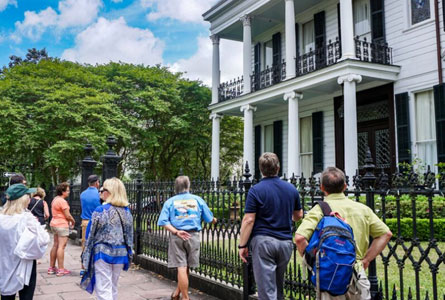
See the Garden District with a guide
A city full of rich history and storied culture, New Orleans holds something for every traveler. Whether you’re bringing the whole family or flying solo, the city and area that surround it will entertain, inform, and amaze you.
Learn More